
The Times


The Romans left Britain in around 400AD. For a time the country continued to be governed in much the same way as it had for the 350 years of Roman occupation. Then chiefs of local tribes began a struggle for power, the country split into several kingdoms. Added to this, Saxon invaders attacked the country with more confidence. Some Saxons were even employed as mercenaries by British leaders to help in the fight against the raiders. These mercenaries settled in the South East and later rebelled against the Britons who had asked for their help.
Saxon influence extended over much of the South East of England by the year 450 AD. As more and more invaders settled, the Britons were pushed westwards into Wales and the South West. To the Romanised Britons these Saxons must have been barbarians. Under the Romans many of the population had become Christians. The pagan customs of the invaders must have added extra impact to the shockwave rippling across the country ahead of their advance. The time was right for a powerful leader to unite the Britons against these outsiders.
Indeed, between the years 500 and 550AD the Saxon advance was halted and a stalemate existed between the Saxons and Britons. It is during this period that Arthur is thought to have existed.
This can come as a shock, for most of us probably picture Arthur riding out from a huge, imposing stone castle ahead of his knights in shining armour. Instead his castle would have been a hill fort, there were many iron age camps which could be quite easily fortified by building wooden palisades and gateways. The armour and weapons would have been modelled on those used by the Romans, in fact some troops may have used actual old Roman equipment.
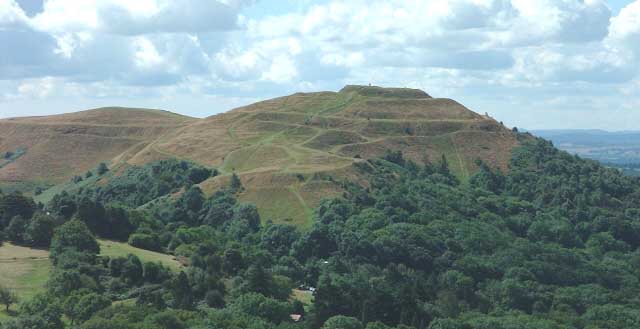
British Camp in The Malvern Hills - an example of an Iron Age Hill Fort.